Category: Education

Disability Education Japan

“Left neglected,” “following precedent”, Japan’s education ministry apologizes for excluding disabled

Saying the practice “left neglected without due consideration” and a case of “following precedent,” the Ministry of Education, Culture, Sports, Science and Technology expressed remorse for long excluding graduates of special needs schools from the School Basic Survey, saying the practice dates back at least to the 1970s, though a review based on interviews with 1980s-era officials failed to clarify how the method was adopted. Education Minister Yohei Matsumoto apologized publicly, bowing before cameras, as the ministry moved to swiftly revise the survey within a month of the issue surfacing amid anger from those affected.

Education Imperial Family Japan Nursing Care

Princess Aiko Attends Ceremony for Chiba University School of Nursing

Japanese Princess Aiko on Sunday attended a ceremony commemorating the 50th anniversary of the founding of Chiba University’s School of Nursing. 
   “I hope that you will continue to thrive while supporting people, and that you will dedicate your efforts to the further advancement of nursing and nursing science,” the princess, the only child of Emperor Naruhito and Empress Masako, said in her speech at the ceremony held at the university in the eastern Japan city of Chiba.  Chiba University is the country’s only national university with a nursing department. Some 400 people, including students and university staff, attended the ceremony.

developmental disabilities Disability Education Japan Podcast

University students with developmental disabilities increase in Japan [Podcast Episode]

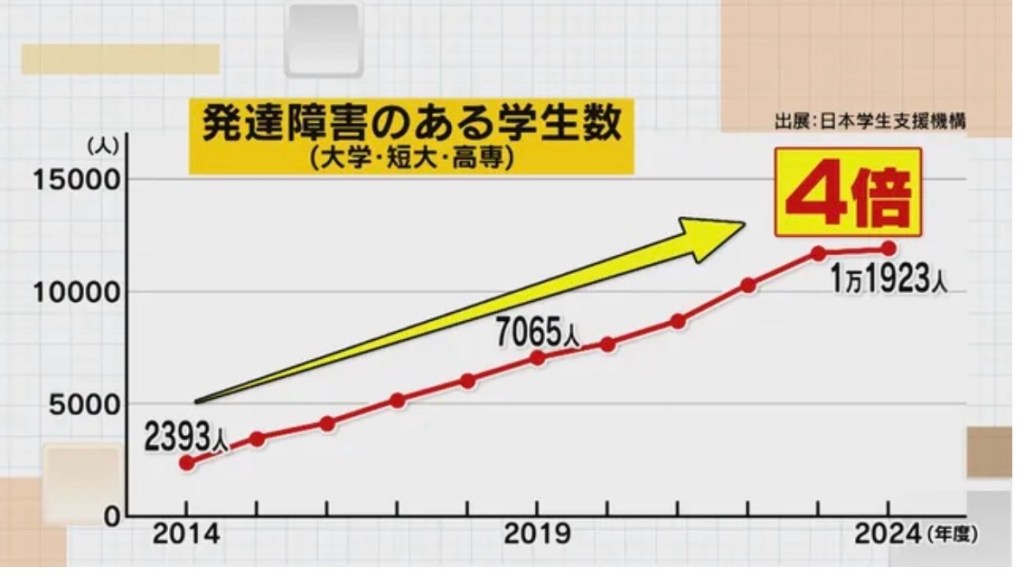
The number of university students with developmental disabilities in Japan is on the rise, with their conditions often identified at a late stage through challenges in their social lives. According to a survey by the Japan Student Services Organization, 14,666 students with developmental disabilities were enrolled in universities, junior colleges and technical colleges in the 2024 academic year, approximately five times the number from 10 years ago.

Disability Education Intellectual disabilities Japan

University students with developmental disabilities increase in Japan

The number of university students with developmental disabilities in Japan is on the rise, with their conditions often identified at a late stage through challenges in their social lives. According to a survey by the Japan Student Services Organization, 14,666 students with developmental disabilities were enrolled in universities, junior colleges and technical colleges in the 2024 academic year, approximately five times the number from 10 years ago.

Abuse Children Crime Education Japan Sexual abuse

Japanese Teacher Admits Sharing Child Pornography

Japanese elementary school teacher Fumiya Kosemura pleaded guilty to charges of sharing child pornography via social media, in the first hearing on his case at Nagoya District Court on Wednesday. The charges are “correct, and I’m very sorry,” said Kosemura, 37, a teacher at a public elementary school in Yokohama, Kanagawa Prefecture, south of Tokyo, who has been indicted for voyeurism and indecent assault. According to the indictment, Kosemura filmed secretly the underwear of a 7-year-old girl at a facility in Kanagawa and shared the video data within the group between January and February this year.

Disability Education Intellectual disabilities Japan

Japan’s Ministry of Education to Examine Appropriate Teaching Methods in High Schools

The Ministry of Education announced plans to review how tsūkyū shidō—a system that allows students with developmental disabilities to take some lessons in separate rooms while remaining in regular classes—can be better implemented in high schools. While more than 200,000 students nationwide now use tsūkyū shidō, the highest number on record, participation among high school students remains limited. Starting next year, the ministry will designate model schools to study effective teaching methods, expand support with a focus on employment after graduation, and promote awareness of the system. It will also research ways to share information between schools and disability support facilities using ICT, and improve teachers’ understanding of severe behavioral disorders.

Children Education Japan Sexual abuse

Japanese Government to Seek Students’ Opinions for Sexual Abuse Prevention

Japan’s Children and Families Agency will hold an in-person session next month to hear the opinions of junior high and high school students on a planned system for checking whether teachers have sexual crime records.  Over the so-called Japanese version of Britain’s Disclosure and Barring Service, the government set up a panel of experts in April to discuss its details, and plans to draw up related ordinances and guidelines later this year and implement them on Dec. 25, 2026. Around 12 students will be selected by lottery from volunteers to participate in the upcoming hearing session at the agency.

Children Education Health Japan Work

Experts Warn of “June Syndrome” among Children in Japan

Experts warn about so-called June syndrome, or mental and physical distress due to accumulating fatigue over the two months since the beginning of April, when many people start new jobs or schools in Japan. Much like the better-known May syndrome, or May blues, June syndrome is a general term for mental and physical disorders and is medically classified as adjustment disorder. Common symptoms include inability to get up in the morning, insomnia, headaches, abdominal pain, dizziness, nausea, malaise and loss of appetite. According to the education ministry, the number of students who refuse to attend elementary or junior high schools totaled a record 346,482 in the 2023 academic year through March 2024. Although there are no monthly data on the start of children’s refusal to go to school, many say that June syndrome is behind the increase in truancy.

Coronavirus COVID-19 Disability Education Japan

Japanese students abroad up 1.5-fold post COVID-19 pandemic

The number of Japanese students who studied abroad in the fiscal year through March 2024 rose 1.5-fold from the previous year to 89,179 following the end of the COVID-19 pandemic, according to a recent survey by a public organization. But the survey conducted by the Japan Student Services Organization also showed that the total was about 26,000 fewer than the peak in the year from April 2018, the highest since comparable data became available in fiscal 2009.