Experience of Blindness Offered in Japan before Paralympics
Participants walk through a temple wearing eye masks for a simulated experience of being blind, including having to make better use of the senses of hearing and smell.
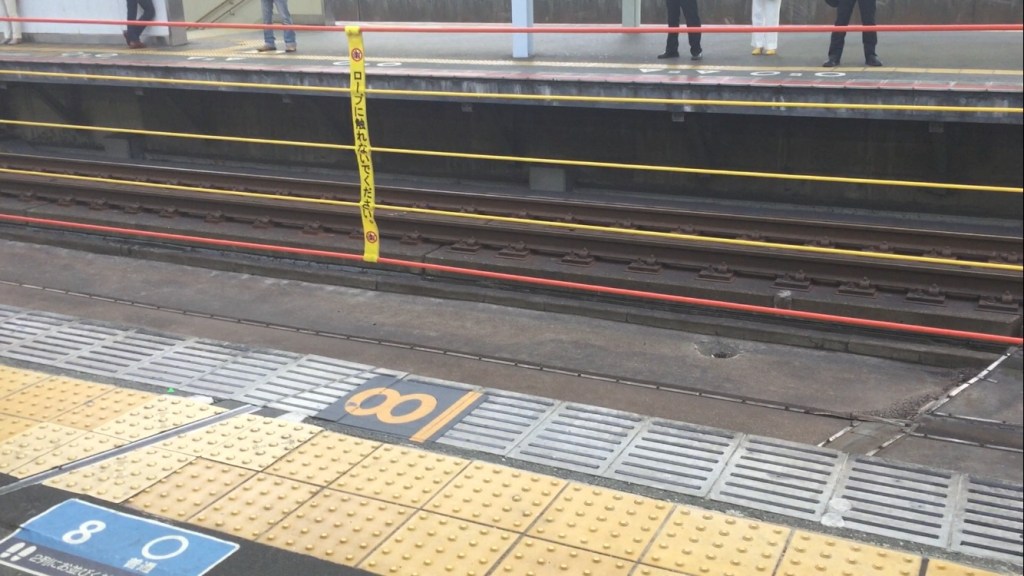
In the early morning of January 11, a 53-year-old visually impaired man fell off his platform at JR Nippori Station in Arakawa-ku, Tokyo, and was killed by a train.
“A railway company renovated a Braille block, in response to an accident in which a visually impaired woman fell and died at a station…The Keisei Electric Railway said, “We will continue to work on safety measures in response to this painful accident.” ”
“Since October began, two blind people have died at a railway stations in Japan.”
“A woman apparently carrying a white cane was hit by a train and killed at Tateishi Station on the Keisei Oshiage Line on the morning of Oct. 1.”
“The Tokyo Olympic and Paralympic Organizing Committee for 2010 did not create Braille materials explaining how to purchase tickets for the tournament or a CD that provides necessary information by voice. A disability organization argues that it is “in violation of the guidelines for ‘barrier-free’ set by the organizing committee.” ”
“Training to open a “welfare shelter” that accepts victims who need assistance such as disabled people when a disaster occurs was held in Hikone City, Shiga Prefecture on the 17th March. Approximately 40 people, including nine visually impaired people and city and center staff, participated in the training conducted at the Shiga Prefectural Center for the Visually Impaired in Hikone City.”
“A young Japanese designer has developed a set of letter designs to be printed on corresponding braille patterns of raised dots, in a bid to help those who do not use braille to understand the language for the visually impaired.
“I hope to bridge the worlds of the visually impaired and other people by using the same tool,” said Kosuke Takahashi, the 25-year-old designer from Tokyo.”
“More than 40 percent of Japan’s major publishing companies do not provide the electronic data for their books and magazines, which would make it easier to convert into Braille or audio for readers with visual impairments, a Mainichi Shimbun survey has found.”
“As the top visually impaired marathon runners prepare for the 2020 Tokyo Paralympics, they are facing an unforeseen hurdle on the path to glory — a lack of qualified guide runners to help them navigate the course.”