Visually Impaired in Japan struggling to book vaccinations
Visually impaired people in Japan are struggling to book COVID-19 vaccinations, as they are often unable to recognize promptly the arrival of a vaccination voucher.
In April, the app “shikAI” that supports the movement of visually impaired people about 200 meters between the exit of Tokyo Metro Higashi-Ikebukuro Station (Higashi-Ikebukuro 4) and the ward office (Minami-Ikebukuro 2) “started to provide voice route guidance.”
While the vaccination program for elderly people aged 65 and over has started in Aizuwakamatsu City, Fukushima Prefecture, a blind man living alone in the city received an envelope containing a vaccination ticket without Braille markings, and it was revealed that he was unable to check the contents for two weeks.
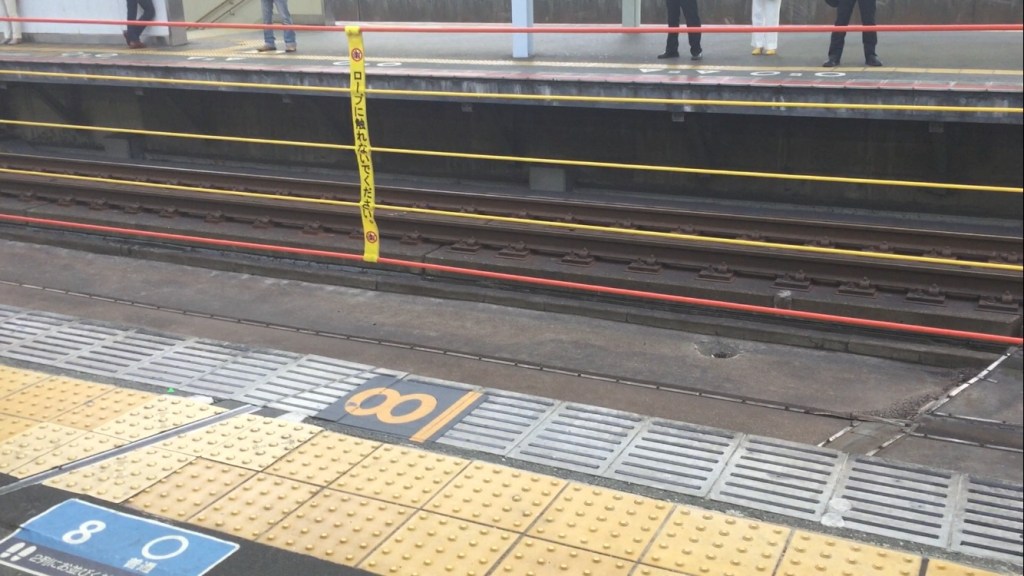
In January of this year, a local group for visually impaired people submitted a request to Tobu Railway to strengthen measures to prevent falls after an accident in which a visually impaired man fell and died at a station in Itabashi Ward, Tokyo.
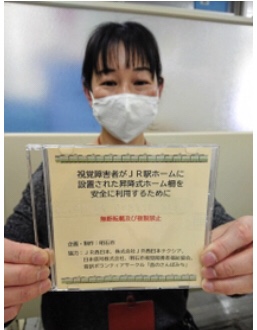
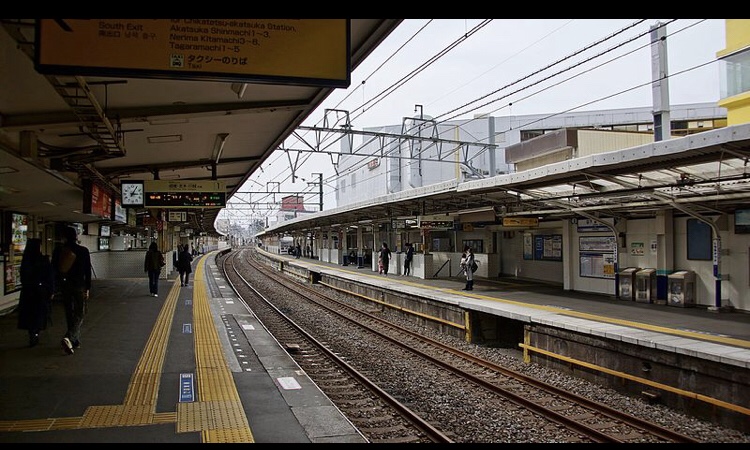
The City of Akashi, Hyogo Prefecture, has produced a CD teaching material to help the visually impaired learn about the platform fences installed at JR Akashi Station and other stations. The CD explains the procedure of walking through the station with a visually impaired person and getting on a train. It also includes an interview with a JR West employee and his impressions of the platform fence.
A study session was held at JR Kanazawa Station on the 16th to verify issues so that visually impaired people can use ticket vending machines smoothly. Yoshifumi Yoneshima (68), the chairman of the Ishikawa Association for the Visually Impaired, and helpers experienced purchasing a ticket using a new ticket vending machine installed on the premises in December last year.
In an accident where a visually impaired man fell from a platform and died at a station on the Tobu Tojo Line in Itabashi Ward, Tokyo, Tobu Railway thoroughly spoke to visually impaired people and turned the edge of the platform red for the time being. The railway have decided to take measures such as calling attention to people with impaired vision.
Tokyo Metro announced on the 18th that it has developed a system that guides the visually impaired people safely in a station by reading a QR code on the Braille block with the camera of the smartphone and guiding the direction and distance by voice. It will be introduced at 5 stations in Tokyo from the 27th.
The National Center for University Entrance Examinations announced on the 17th and 16th that there was a mistake in the question booklet prepared for the visually impaired in the public examination of the common university entrance test. There is a special question booklet with enlarged letters, and two students nationwide used it. There were no mistakes in the questions in the regular booklet.
A survey conducted by the Japanese newspaper The Mainichi Shimbun that more than 80% of Japan’s accessible pedestrian signals, traffic lights that also produce sounds to let pedestrians with visual impairments know when it’s safe to cross the road, have their noise-making function muted for at least part of the day, the newspaper’s survey of the country’s 47 prefectural police forces has found.