Category: Welfare

Abilympics Disability Employment Japan Podcast Welfare

Tokyo Metropolitan Government Seeks Competitors for Tokyo Abilympics for February 2027 [Podcast Episode]

The Tokyo Metropolitan Government will hold the 25th Tokyo Skills Competition for Persons with Disabilities, known as the Tokyo Abilympics, on Feb. 20, 2027, and will accept applications from Oct. 19 to Nov. 13. Applications must be submitted through an online form to be published on the website of the organisation’s Tokyo branch. Applicants’ eligibility will be reviewed, and participants will be selected and notified individually. Selection may be necessary if applications exceed the available places.


Abilympics Disability Employment Japan Welfare

Tokyo Metropolitan Government Seeks Competitors for Tokyo Abilympics in February 2027

The Tokyo Metropolitan Government will hold the 25th Tokyo Skills Competition for Persons with Disabilities, known as the Tokyo Abilympics, on Feb. 20, 2027, and will accept applications from Oct. 19 to Nov. 13. Applications must be submitted through an online form to be published on the website of the organisation’s Tokyo branch. Applicants’ eligibility will be reviewed, and participants will be selected and notified individually. Selection may be necessary if applications exceed the available places.

Disability Japan Podcast Welfare

Japan Disability Pension Applicants Face Hurdles Proving Medical History [Podcast Episode]

A total of 11.4% of disability pension applicants in Japan were denied benefits in fiscal 2025 because their disabilities did not meet eligibility criteria or because of incomplete documentation, according to Japan Pension Service statistics. Although the rate fell from a record 13.8% in fiscal 2024, concerns remain that applicants can struggle to obtain the medical records and other documentation needed to prove their eligibility, particularly when treatment dates back decades. Medical institutions are generally required to retain medical records for only five years, meaning applicants may have difficulty proving the date of their first consultation or diagnosis when older records have been disposed of. The Japan Federation of Bar Associations has criticized aspects of the certification process and called for fairer disability pension assessments.

Disability Japan Welfare

Japan Disability Pension Applicants Face Hurdles Proving Medical History

A total of 11.4% of disability pension applicants in Japan were denied benefits in fiscal 2025 because their disabilities did not meet eligibility criteria or because of incomplete documentation, according to Japan Pension Service statistics. Although the rate fell from a record 13.8% in fiscal 2024, concerns remain that applicants can struggle to obtain the medical records and other documentation needed to prove their eligibility, particularly when treatment dates back decades. Medical institutions are generally required to retain medical records for only five years, meaning applicants may have difficulty proving the date of their first consultation or diagnosis when older records have been disposed of. The Japan Federation of Bar Associations has criticized aspects of the certification process and called for fairer disability pension assessments.

Disability Japan Welfare

Nagano Social Welfare Corporation Fires Staff Member for Embezzling Over 6.7 Million Yen from Resident Deposits

According to the corporation, the male employee in his 50s, who worked at a support facility in the prefecture, embezzled a total of over 6.7 million yen from the deposited funds of 12 residents over roughly nine years, from February 2017 to March of this year. He operated by submitting forged receipts to make it appear as though he was making authorized purchases on behalf of the residents.

Care Dementia Disability Independent Living Intellectual disabilities Japan Welfare

Waiting List for Independent Living Support in Japan Reaches 1.4 Times Previous Year’s Level

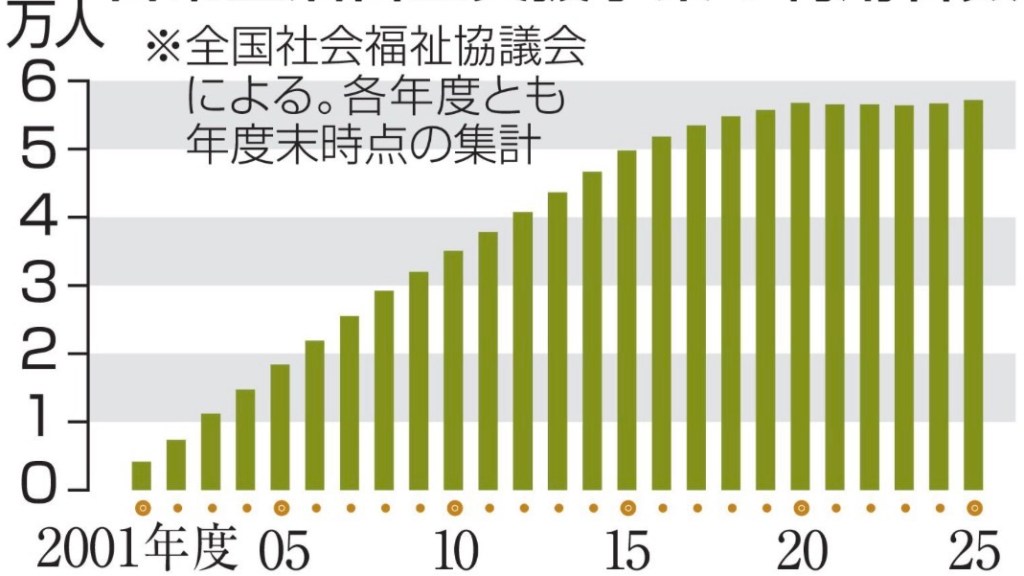
was learned on September 19 that the number of people waiting to use the “Daily Living Independence Support Program,” provided by social welfare councils across Japan for people with dementia, intellectual disabilities and other conditions, totaled 3,931 in fiscal 2025. This was about 1.4 times the 2,868 recorded in fiscal 2024. The main reason for the sharp increase is a shortage of social welfare council staff in the face of growing demand for the service. The government plans to expand the program to elderly people who have no relatives they can rely on, making it an urgent priority to strengthen the system.

Children Disability Japan Welfare

Daily Food Spending below 500 Yen among Needy People in Japan

Needy households in Japan live on an average food expenditure of less than 500 yen per person a day amid lingering inflation, according to a survey by Save the Children Japan, a nongovernmental organization. The survey, conducted in June, covered 8,736 parents nationwide who applied for food assistance from the organization. All of them provided valid responses online or by telephone.

Disability Employment Japan Welfare

Yamaguchi Prefecture Revokes Designation of Employment Support Facility for People with Disabilities Over Fraudulent Benefit Claims

A non-profit organization (NPO) based in Yamaguchi City has fraudulently received at least approximately 19.43 million yen in benefit payments from four municipalities, including Yamaguchi City, without employing a “service management supervisor” as required by the Comprehensive Support for Persons with Disabilities Act. The disciplinary action was decided on the 10th and takes effect on September 29th. The sanctioned entity is the NPO “felice,” which operated the employment support facility “Ayu no Sato” in the Yoshiki-Sahata district of Yamaguchi City.

Care Disability Elderly Japan Nursing Care Welfare

Japan Mulls Easing Nursing-Care Premiums for Missing Elderly People

The Ministry of Health, Labour and Welfare has, for the first time, indicated that nursing-care insurance premiums can be fully exempted when elderly people, including those with dementia, go missing and their families continue to be responsible for paying the premiums. The ministry has notified local governments across Japan of this policy.