
Disability News Japan Podcast:”My Name Is Junko Iizuka, I Was Forced To Undergo Eugenics Surgery”
By Barrier Free Japan June 23 2023 JAPAN – The audio in this podcast is a short extract from ‘TheContinue Reading
By Barrier Free Japan June 23 2023 JAPAN – The audio in this podcast is a short extract from ‘TheContinue Reading
On June 21, an interview with the Hokkaido prefectural government revealed that a person with a mental disability who wished to get married or live together at a group home run by Asunaro Fukushikai, a social welfare corporation in Esashi, Hokkaido (Hidetoshi Higuchi, president), stated that he “felt as if he was forced to do so” when asked by the prefectural government about the sterilization procedures being performed on him.
Referring to findings in the Diet report, an 80-year-old victim of forced sterilization at age 14, said it showed the government “had been doing terrible things by deceiving children.”
“I would like the state not to shroud the issue in the darkness but take our sufferings seriously soon,” the victim, who goes by the pseudonym of Saburo Kita, said at a news conference.
A report on forced sterilizations of people with disabilities carried out under the now-defunct eugenic protection law was submitted to the chiefs of both chambers of the Diet, Japan’s parliament, on Monday.
According to the report, there were cases in which sterilization operations were carried out under false pretenses, as well as those conducted without the holding of necessary screening panel meetings.
Japanese authorities have drawn up a draft investigative report shedding light on how thousands of people were forcibly sterilized under the now-defunct Eugenic Protection Law.
National statistics show that roughly 25,000 people underwent sterilization under the eugenics law, including those who did give their consent for the surgery. The law had authorized surgery without consent on people with mental or genetic disabilities to prevent the birth of what the law called “inferior descendants”. It was scrapped in 1996.
A report to be submitted to the speakers of both chambers of the Diet, Japan’s parliament, as early as Monday will reveal that 9-year-old children were among the disabled people forced to undergo sterilization under the now-defunct eugenic protection law, a draft of the report showed Saturday.
According to the draft, the 1,400-page report will note that sterilization under the law peaked in 1955, and that a total of about 25,000 people are believed to have had sterilization surgery, with 66 pct of them sterilized without their consent.
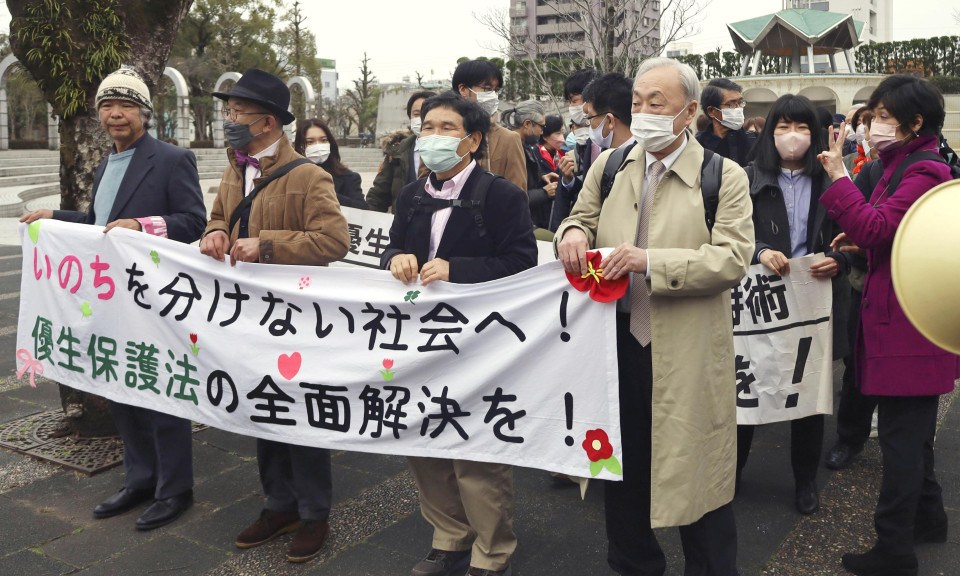
A Japanese court on Friday ordered the government to pay damages to a hearing-impaired woman who underwent forced sterilization under a now-defunct eugenics protection law, the fourth such ruling.
The Shizuoka District Court found the 1948 law unconstitutional and awarded 16.5 million yen ($123,000) to the plaintiff, a resident of the central Japan prefecture, who filed the lawsuit in 2019 claiming she underwent sterilization surgery in 1970.
It is the fourth case in which damages have been awarded over forced sterilization, following rulings by the Tokyo and Osaka high courts and the Kumamoto District Court.

Kumamoto District Court, presided over by Judge Yuichiro Nakatsuji, found that the law was unconstitutional, and denied the application to the case of the 20-year statute of limitations on compensation claims.

A southwestern Japan court ordered the national government on Monday to pay a total of 22 million yen in damages over the forced sterilization of two people under the now-defunct eugenic protection law.
Kumamoto District Court, presided over by Judge Yuichiro Nakatsuji, found that the law was unconstitutional, and denied the application to the case of the 20-year statute of limitations on compensation claims.
On December 18th a ‘group home’ operated by Asunaro Social Welfare Service Corporation in Esashi, Hokkaido, admitted that it had made sterilization a condition for couples with intellectual disabilities for more than 20 years.

 Barrier Free Japan