

From The Yomiuri Shimbun via Yahoo! Japan
May 7 2026
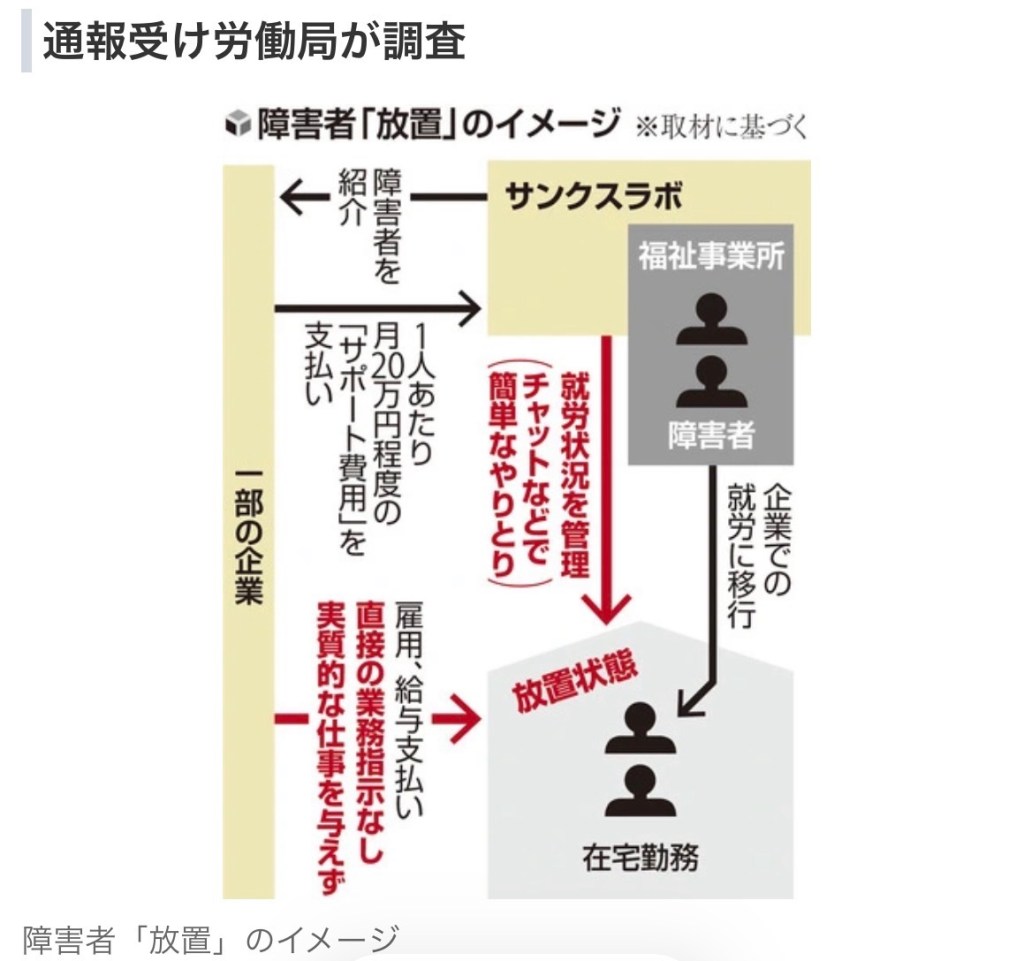
TOKYO – It has been learned that there have been repeated cases in which disabled people directly employed by companies through intermediaries operating disability employment businesses were given virtually no actual work while working remotely, and were effectively left abandoned, doing little more than exchanging simple chat messages with the intermediary company. The cases reveal a structure in which companies seeking to meet the legally mandated employment quota for disabled workers (currently 2.5% of employees) hired disabled people only in form while paying salaries, then completely outsourced employment management to outside contractors.
There are suspicions that this deviates from the principles of Japan’s Act on Promotion of Employment for Persons with Disabilities, which calls for creating environments in which disabled people can fully demonstrate their abilities. The government classifies “neglect” as one form of abuse against disabled persons, and labor bureaus that received reports from disabled workers are investigating some of the companies contracted with the intermediary business.
The company in question is Thankslab, based in Naha, which has around 50 locations across Kyushu, Okinawa, Hiroshima, Tokyo and elsewhere. Since 2019 it has operated a business introducing disabled people enrolled in its welfare facilities to corporate employers. The disabled workers are employed either at Thankslab facilities or from home, while the company receives “support fees” of around 200,000 yen per worker per month from client companies.
Its clients include major corporations. Among them, the major travel agency Nippon Travel Agency employed 18 disabled workers through Thankslab from October 2024 onward, but left employment management entirely to the intermediary company and had no direct contact with 14 employees working remotely.
One of those 14 workers, a woman in her 30s in western Japan with a physical disability, repeatedly engaged in self-study on how to use spreadsheet software under the label of “training.” There were occasional short online interviews with Thankslab staff, but otherwise she merely notified the company through chat messages when beginning and ending work. Feeling doubtful about the situation, she resigned and told reporters, “I was never given work, and my desire to work was trampled on.”
A man in his 50s living in Kyushu who had been employed by the Japanese arm of the French luxury brand Louis Vuitton Japan similarly spent his time repeatedly studying alone at home. He said the isolation worsened symptoms related to his mental disability, and he resigned before the end of his contract.
Labor bureaus are expected to instruct companies including Nippon Travel Agency and Louis Vuitton Japan to properly manage disabled employees. Nippon Travel Agency said in response to inquiries that “there were compliance-related problems” and indicated it plans to terminate its contract with Thankslab. Louis Vuitton Japan said it was “responding based on advice from the labor bureau.”
Thankslab stated, “In some cases, the relationship and division of roles between employing companies and our company were not clearly defined, and coordination was insufficient. We are moving forward with improvements.”
Japan’s Health, Labor and Welfare Ministry said, “We have received numerous concerns regarding the expansion of disability employment businesses, and we would like to deepen discussions toward resolving the issues.”


0 comments on “Disabled workers in Japan left “with no work assigned and abandoned”, companies outsource employment management to contractors”