
By Barrier Free Japan
February 6 2026
KOBE – A meeting held in Kobe by the Independent Living Center ‘Ring Ring’ on January 24th 2026 drew together disability rights advocates and community organizers calling for an end to institutionalization following recent reports of violence at residential care facilities in Hyogo Prefecture. The gathering, organized by independent living groups, highlighted concerns that segregated living environments heighten the risk of abuse and isolate people with disabilities from society. Participants urged authorities to expand community-based support systems and accelerate Japan’s shift toward deinstitutionalization in line with international human rights standards, including the U.N. Convention on the Rights of Persons with Disabilities.
The event was called for after a very serious incident was reported on November 27th 2025; when at a facility for people with disabilities in Sanda City, Hyogo, a resident with both intellectual and physical disabilities was subjected to violence by staff and later died.The meeting was co-hosted by ‘Remember 7.26 Kobe Action’ and the event featured speakers from ‘Hyogo People First’ and focused on disability rights and the need for community-based living.
The meeting ended with the following conclusions:
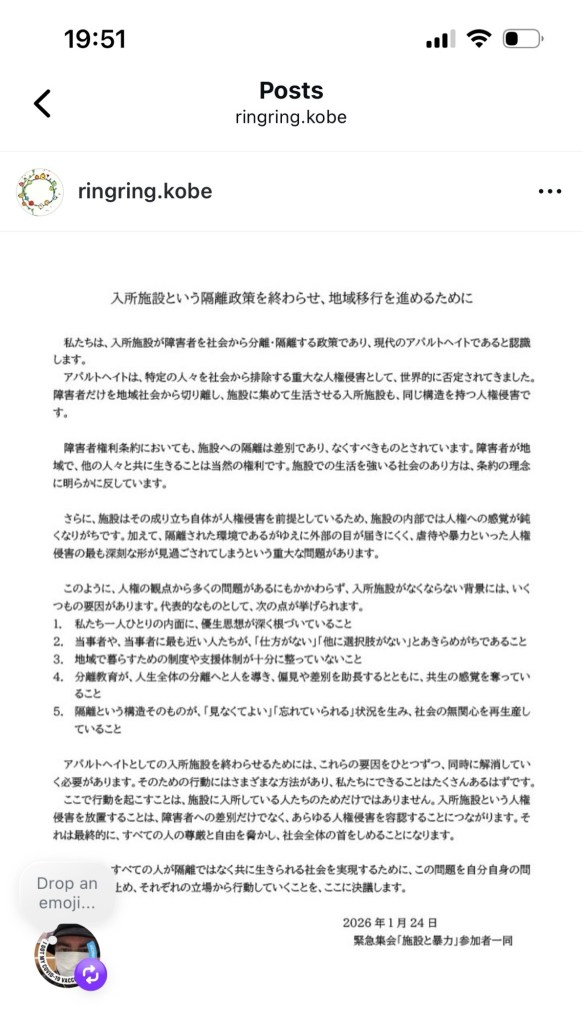
“To End the Segregation Policy of Institutionalization and Promote Transition to Community Living
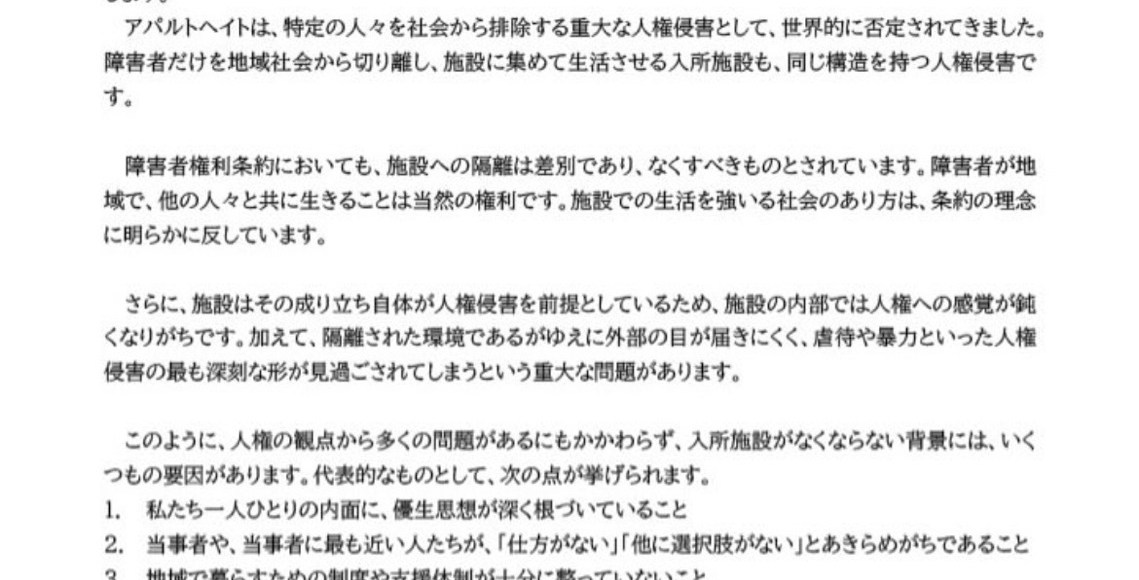
We believe that residential institutions are a policy that separates and isolates people with disabilities from society, and that they constitute a form of modern-day apartheid.
Apartheid has been globally condemned as a grave human rights violation that excludes specific people from society. Likewise, residential institutions that cut people with disabilities off from local communities and make them live collectively in facilities share the same structural characteristics as such human rights violations.
Under the Convention on the Rights of Persons with Disabilities, segregation in institutions is regarded as discrimination and something that must be eliminated. It is a natural right for people with disabilities to live in the community together with others. A society that forces life in institutions clearly contradicts the principles of the Convention.
Furthermore, because institutions are founded on the premise of human rights violations, awareness of human rights tends to become dulled within them. In addition, because they are isolated environments, they are less visible to outside scrutiny, creating serious problems in which the most severe forms of abuse and violence go undiscovered.
Despite these many human-rights concerns, institutionalization continues to exist for several reasons. Representative factors include:
Eugenic ways of thinking remain deeply rooted within each of us.
Persons concerned and those closest to them often feel “it can’t be helped” or “there is no other choice.”
Systems and support structures for living in the community are not sufficiently developed.
Segregation leads to division throughout people’s lives, fosters prejudice and discrimination, and erodes the sense of coexistence.
The very structure of segregation creates situations where people are “out of sight” and “forgotten,” reproducing social indifference.
To end institutional segregation as a form of apartheid, it is necessary to eliminate these factors one by one and simultaneously. There are many possible actions toward that goal, and there must be much we can do.
Taking action here is not only for those currently living in institutions. Allowing the human rights violations of institutionalization to continue leads not only to discrimination against people with disabilities but to tolerating all forms of human rights abuse. Ultimately, it undermines the dignity and freedom of everyone and impoverishes society as a whole.
To realize a society where all people can live together rather than in segregation, we resolve to treat this issue as our own and to take action from each of our respective positions.”
 Barrier Free Japan
0 comments on “Kobe Meeting Calls for End to Institutionalization and Violence Against People with Disabilities”