
From BSN Niigata Broadcast/TBS via Yahoo! Japan
March 20 2026
Niigata – Are you familiar with a condition called “higher brain dysfunction,” which is caused by damage to the brain due to things like stroke or accidents?
Because it is not visible from the outside, it is sometimes referred to as an “invisible disability,” and the families of those affected often struggle with hardships that are difficult for society to understand.
On March 18, a gathering for people supporting family members with higher brain dysfunction was held in Niigata City.
“In the end, I was hit… (Hit? By the person affected?) Yes, that’s right.”
“They can walk normally, so people around them think they’ve gone back to normal (that’s why it’s called an ‘invisible disability’). That’s probably the hardest part.”
Higher brain dysfunction refers to impairments that occur when the brain is damaged by a stroke, traffic accident, or similar causes.
Symptoms include:
Memory disorders, such as “forgetting events” or “losing things” Attention disorders, such as “not being able to follow conversations” or “being unable to concentrate” Executive function disorders, such as “being unable to prioritize” or “unable to correct mistakes” Behavioral and emotional disorders, such as “becoming irritable” or “being unable to control impulses”
It is estimated that there are about 227,000 people nationwide with the condition, including around 3,800 in Niigata Prefecture.
“The feeling at that moment really was… that they had survived.”
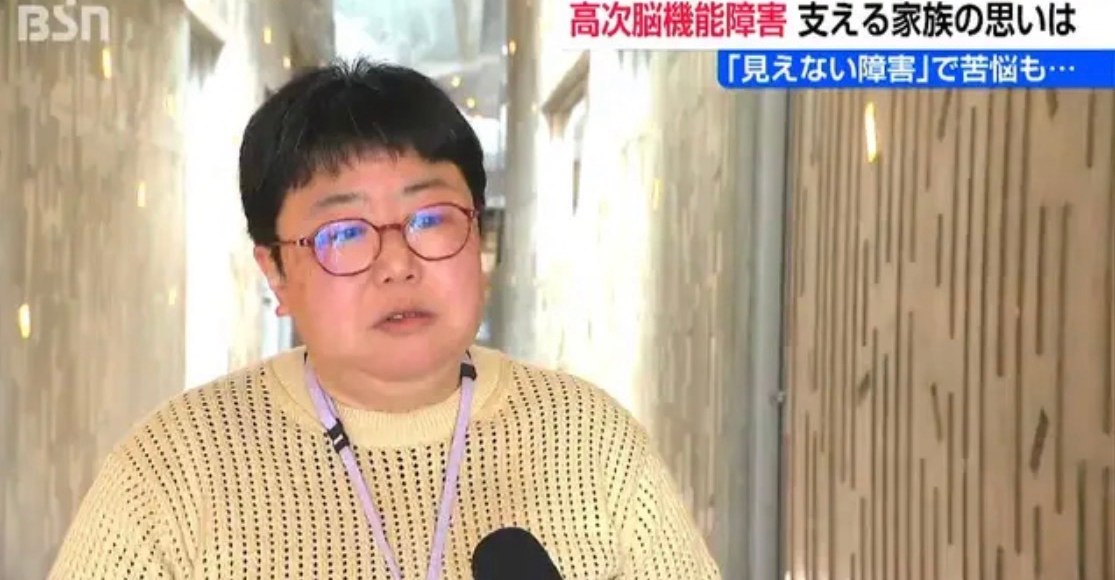
This is what Ayako Toyama, the representative of the group, says.
Twenty-two years ago, her mother—then 48—collapsed from a cerebral hemorrhage, and since then has been unable to control her emotions. Toyama, who was 25 at the time, was bewildered by the changes in her mother.
Ayako Toyama, representative of the family support group “Nee Nee”:
“I kept wondering, ‘Why has she become like this?’ ‘Why are such words coming out?’ I truly felt alone.”
Toyama says she felt relieved after attending a prefecture-organized gathering for families and realizing she was not alone. Wanting to create a place of support for families herself, she launched the mutual support group “Nee Nee” in January 2025.
The group now holds monthly tea gatherings.
Participants freely share their daily struggles.
“With this shirt, on Tuesday it has to be this rice ball—if you get it wrong, it’s a huge deal, you get yelled at. They were never like that before—they were such a kind person.”
“If the caregiver starts to break down, the problems just pile up.”
An elderly woman in her 80s who attended said her son developed higher brain dysfunction after an accident during a junior high school club activity.
“It was the end of the Showa era, so the term ‘higher brain dysfunction’ didn’t even exist. And even among people here, each person’s symptoms are different, so it’s very hard to get others to understand.”
A woman in her 50s from Kamo City, whose younger brother has the condition, said:
“Hearing how others handle situations feels like receiving information in the middle of a fog.”
Toyama added:
“After discharge from hospital, families walk alongside the person affected. We share our difficulties with others in the same situation. Solutions may be hard to find, but if it helps us take even one step forward into tomorrow…”
In April, a law to support people with higher brain dysfunction will come into effect.
While Toyama welcomes increased awareness of this “invisible disability,” she also hopes the government will provide support for families.
“It’s the families who support the person affected, so please don’t forget that. Try to relax as usual, even if it’s just for a minute—take some time for yourself, and let’s make it through to next month.”
 Barrier Free Japan
Pingback: 227,000 people in Japan have “Higher Brain Dysfunction” [Podcast Episode] – Barrier Free Japan