

By Barrier Free Japan
April 21 2025
TOKYO – Publisher Mikasa Shobo released a press statement on April 18th addressing the criticisms of the book ‘Psychological Techniques to Skillfully Handle Difficult People in the Workplace” by Yuko Kanda ahead of its publication on April 22nd.
The book received some criticism ahead of going on the shelves as some critics claim it promotes discriminatory views by categorizing people suffering from conditions such as autism spectrum disorder (ASD), ADHD, depression, and trauma disorders as animals — and portrays them as “troublesome people in the workplace.” Critics also point out that the illustrations used in the book, where autism is depicted as a sloth and ADHD as a monkey (who may steal colleagues’ work) “uses expressions that incite hate.”
In the April 18th press release, Mikasa Shobo stated:
We would like to express our views regarding the various opinions that have arisen online about the advance publicity for the above book (hereinafter referred to as “the book”), particularly regarding its visual design, terminology, and table of contents.
We sincerely apologize to anyone who felt discomfort or displeasure due to the limited information released in advance of the book’s publication, which gave rise to criticism and concern.
Until now, we have refrained from commenting on readers’ opinions after our books are published, as we take them seriously. However, given the reactions to this book’s advance promotion, we discussed whether we should clarify our understanding. In light of the ongoing criticism, we have judged it necessary to share the book’s contents and our stance.
The press release goes on to say:
This book is written based on the reality that there are individuals in workplaces and organizations who are considered “difficult people,” and it aims to help others avoid conflict and prevent trouble through mutual understanding.
However, rather than accepting this trend at face value and labeling individuals as “difficult,” the book discusses how to approach these situations thoughtfully and how to engage with such individuals constructively. This is the basic perspective from which the author addresses the topic.
To that end, the author emphasizes in Chapter 1 (pp. 19–21) the importance of understanding “difficult people,” classifying them into six types as a guide to better comprehension. A simplified diagnostic chart is also provided (pp. 24–25), with explanations of each type following (pp. 26–59).
Building on this, the book stresses the importance of the mindset of those dealing with “difficult people.” It promotes the attitude of “understanding others while respecting them” (pp. 60–71). It then introduces concrete communication techniques (pp. 72–79), emphasizing respectful and appropriate application of these tools.
In addition, it presents practical examples for each type (pp. 81–187), along with further strategies and responses.
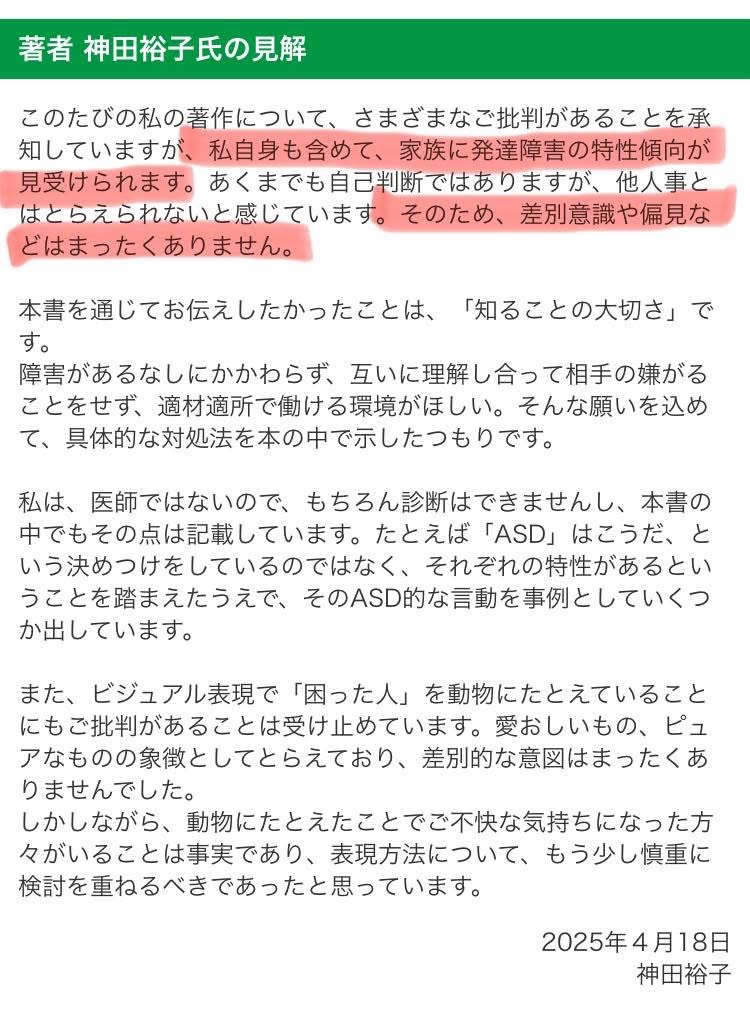
It further gave what appeared to be a statement from the author herself:
“Including myself, there are traits within my family that are characteristic of developmental disorders. Although this is merely a self-assessment, I do not see myself as entirely separate from those affected. Therefore, I hold absolutely no discriminatory intent or prejudice.”
 Barrier Free Japan
0 comments on “Ahead of Going On Sale Publisher of Controversial Book Depicting Neurodivergent People as Animals and as ‘Difficult’ Responds to Criticism”