
From FNN via Yahoo! Japan
March 26 2026
TOKYO – The number of students diagnosed with developmental disabilities is increasing. A key issue is how schools provide support. This report looks at both students struggling with disabilities and efforts by universities.
Diagnosed with ADHD as the cause of poor health
“My weight dropped rapidly by about 10 kilograms in three weeks, and after that my daily life stopped functioning properly.”
Miki (pseudonym), a fourth-year student from April at Kyushu University’s Ito Campus in Nishi Ward, Fukuoka City, says her university life has not been smooth.
Partway through her first year, she became unwell and was unable to attend most classes. She even considered dropping out. In desperation, she went to a hospital, where she learned that the root cause of her condition was ADHD.
ADHD is one type of developmental disability. Miki finds it difficult to manage schedules and focus on a single task. “When an alarm goes off 30 minutes before something, I think, ‘Oh, I needed to get ready,’ and start preparing. But even then, I sometimes forget again afterward,” she says.
Until graduating from high school, she had not experienced major difficulties. At university, however, she struggled to manage her daily schedule independently, leading to disruptions in her life and health.
“I’m really bad at things that aren’t routinized like high school classes. I think that caused a lot of stress,” she recalls.
Increasing number of students reporting developmental disabilities
Now diagnosed with ADHD, Miki has disclosed her condition to the university and continues her studies.
She says she felt “honestly relieved” after the diagnosis. She had worried that even if she went to a hospital, she might not be told she qualified for support. “It made me feel that I’m allowed to receive support after all,” she said.
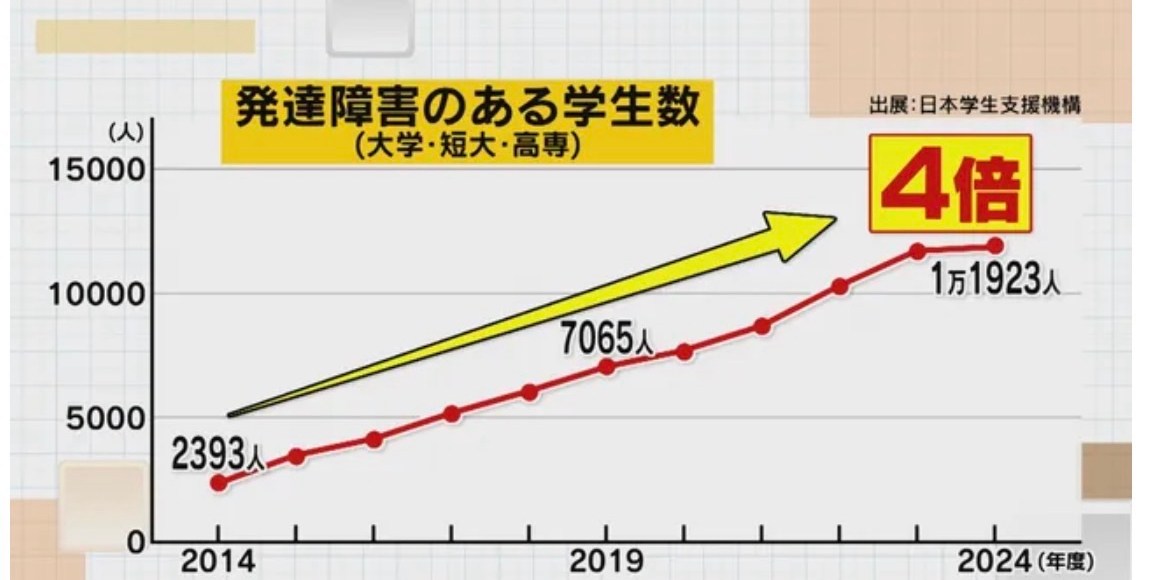
Like Miki, the number of students disclosing developmental disabilities to their schools has been rising each year, partly due to growing social awareness. In 2024, the nationwide total reached nearly 12,000—more than four times the figure from ten years ago.
At Kyushu University, the number is also increasing, with 62 students reporting disabilities in the 2024 academic year. The university has been promoting measures known as “reasonable accommodations,” such as extending assignment deadlines or allowing exams to be replaced with coursework.
Peer supporters also assist students at Kyushu University
“Reasonable accommodation” at universities refers to necessary and appropriate adjustments made so that students with disabilities can equally enjoy and exercise their right to education. Based on laws such as the Act for Eliminating Discrimination against Persons with Disabilities, which came into effect in April 2016, universities are legally required to provide such measures.
Yukinori Wakihama, an assistant professor at Kyushu University’s Inclusion Support Promotion Office, explains: “Some students may not realize that their developmental disability is creating barriers to learning. This process gives them an opportunity to think about what adjustments would make studying easier and ensure access to learning opportunities.”
Kyushu University also emphasizes a “peer supporter” initiative, in which volunteer students support those with disabilities. Only a small number of universities nationwide offer peer support specifically for students with developmental disabilities. Participants meet once a week to gain the knowledge needed to support students with disabilities.
Miki also receives support from peer supporters. On this day, she reviewed her academic credits and discussed goals for the coming year with a student supporter.
When asked, “Are your assignments going okay?” Miki responded honestly: “I missed the deadline.” She added, “I couldn’t submit certain types of assignments I struggle with, but I think it was a big achievement that I was able to study for exams.”
Miki was able to reflect objectively on herself and positively analyze areas of improvement. “It must have been quite tough, with this number of assignments,” said Yurinka Fukabori, a third-year education student and peer supporter, responding to Miki’s comments.
“It’s hard to talk about your struggles, especially with people close to you. Being able to discuss them here is something I’m really grateful for,” Miki said. Peer supporters have become an indispensable presence for her.
Kenshin Furuse, a fourth-year law student involved in peer support activities, also says he feels the program is effective. “At first, I worried about whether it was okay to say certain things and was overly cautious. Now we’ve become more relaxed, and I feel we can support each other in a friendly, positive way.”
Masayoshi Ogura, a professor specializing in developmental clinical psychology at Naruto University of Education, commented: “Some people may have found the barrier to entering university high because of their disabilities. But if support systems and accommodations are available, I hope more will decide to pursue higher education.”
With the increase in students disclosing developmental disabilities, all universities—including private institutions—now provide various forms of support. Continued efforts by universities are needed to ensure equal access to learning opportunities.
 Barrier Free Japan
0 comments on “Students with Developmental Disabilities Rise to 12,000 Nationwide in Japan”