
From The Asahi
November 23rd 2024 (originally Nov 5)
OSAKA – The Osaka High Court here made a rare acquiescence in allowing laptops during a trial for an audience member in the gallery who was not personally connected to the case.
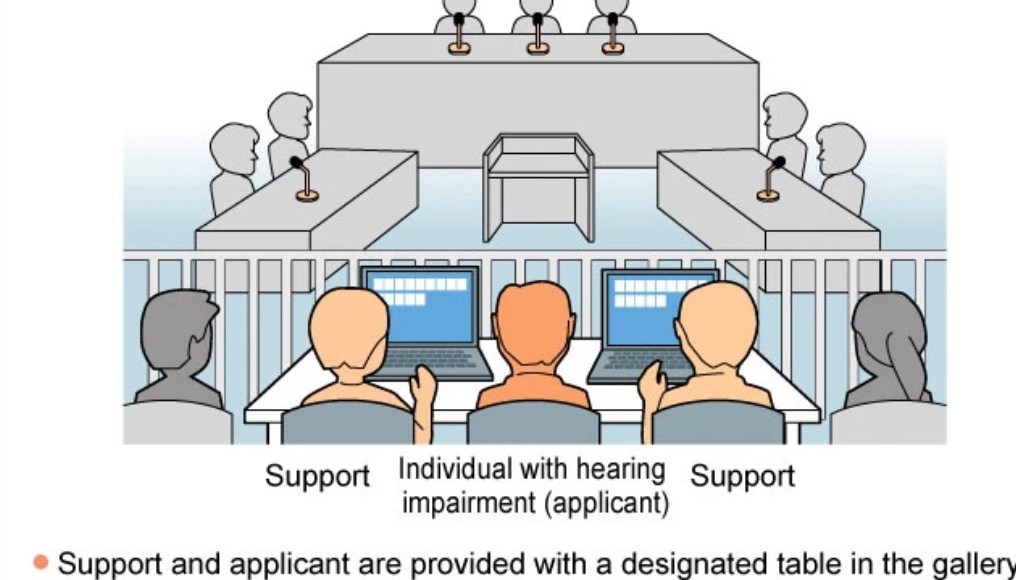
Spectators are typically not permitted to use electronics, but the individual relies on speech-to-text technology due to impaired hearing and was interested in attending the trial after learning about it through the media.
A written application to the high court was submitted ahead of the Sept. 30 hearing for an anti-stalking law case, saying the accommodation would not disrupt proceedings.
The high court not only approved the application, it provided designated seating after contacting the individual’s municipal government to request staff to transcribe the trial.
The municipal government agreed to coordinate, saying that observing a court case is an important way to participate in society.
The live transcriptions allowed the individual to read along while sitting next to staff.
The judge, prosecution and defense also used microphones during the trial.
“I’m glad that my application was accepted,” the individual said. “I hope environments will be established where everyone, regardless of situation, can observe court proceedings whenever they want and they can understand what is happening in the court properly (through reasonable accommodations).”
When deciding on the accommodations, the high court explained that it did what made sense for the case.
The Supreme Court declared “reasonable accommodation” must be provided following its 2016 enforcement of a law banning disability-based discrimination.
During its July ruling of the unconstitutionality of the eugenics law, the costs for sign language interpreters for the gallery were covered by the court for the first time.
Tamano Tsujikawa, a lawyer who specializes in protecting the rights of people with disabilities, praised the high court’s accessibility efforts.
“The right to observe a court case must be guaranteed equally for everyone. In this case the high court provided reasonable accommodation for the audience member despite them being an outlier,” she said. “What the high court did is a step ahead of the Supreme Court’s previous accommodation.”
While this instance was straightforward, Tsujikawa noted that some municipal governments do not provide services if the applicant is “not the party involved in the case.”
“Public access to trials is an important principle established by the Constitution,” she said. “I hope public funding also covers the cost of providing reasonable accommodations toward watching court cases.”
 Barrier Free Japan
0 comments on “Osaka High Court Allows Laptop So Hearing Impaired Spectator Can Use Speech-to-Text Technology”