
By Barrier Free Japan
August 14 2024
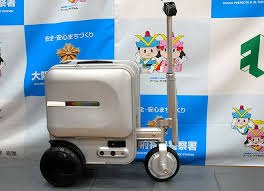
OSAKA – In March 2024, a Chinese student in Fukushima Ward in Osaka City was stopped by the police for using an ‘electric suitcase’ on the sidewalk.
According to The Asahi Shimbun the 30-something year-old student said, “I didn’t think that the electric suitcase was a vehicle, so I didn’t think that I had to have a license.”
Since the woman’s suitcase could reach a maximum speed of 13 kph, the police classified the luggage as a motorized bicycle after noting that it has all the traits of a vehicle, therefore using such an ‘electric suitcase’ is a potential violation of the Road Traffic Law and the Prefectural police referred the woman to prosecutors on suspicion of violating that law. This is the first time such a case has been sent to the prosecutors.
The student has denied the charges.
Perhaps it is understandable to many that it should be referred to the prosecutors. Electric suitcases do not meet public safety standards and therefore cannot be ridden on a public road. It could be that 13 kph is an apparently dangerous 8 and bit miles per hour, and having looked at a photograph of the electric suitcase, it could be considered sizeable. However, if electric suitcases “do not meet public safety standards”, we can wonder why we consider electric wheelchairs to have met “public safety standards”, perhaps it is just the fact that denying electric wheelchairs on the sidewalk would deny many elderly and people with disabilities access to the world outside their home. We can ask: other than that the electric suitcase seems ‘optional’ to some people – it may not be to a person with disabilities, to them like the wheelchair, it may be a necessity – why are different rules seemingly applied to suitcases and wheelchairs, with the former classed as a vehicle and the latter not?
When thinking about this issue, here are some interesting facts about electric vehicles in Japan to consider.
Japan’s welfare ministry is collaborating with the private sector to consider ways to promote electric wheelchairs as a means of transportation for elderly people.
In September 2019, the Japanese government started to promote electric wheelchairs as a means of transportation to replace automobiles at a time when elderly people are increasingly returning their driver’s licenses and specifically promoting the Suzuki ET4D model, which one can acquire for a mere ¥368,000. It has advanced safety functions and it can even give verbal instructions when it approaches a steep slope. The ET4D also features a large basket and a range of as much as 31 km after a full charge, at least according to Suzuki Motor Corp.
It is also worth considering that from July 2023, people in Japan were allowed to use e-scooters without a driver’s license, as was announced by the National Police Agency in January 2023:
“Japan’s electric scooter users will no longer require a driver’s license from July, though people under 16 will be banned from riding the vehicles, the National Police Agency said Thursday. The new rules apply to scooters with a maximum speed of 20 kilometres per hour, and riders must comply with the same traffic rules as cyclists, including, in principle, not riding on sidewalks. Scooter riders are advised to wear helmets, although it is not compulsory.”
Electric scooters that come under the new rules must measure 190 centimetres or less in length and 60 cm or less in width. They may also be used on sidewalks as long as their maximum speed is set to 6 kph or less, similar to electric wheelchairs.
So 6 kph or less if you are using an e-scooter or electric wheelchair on the sidewalk, maybe that is reasonable. However, again, I can’t help but wonder if e-scooters and electric wheelchairs going under 6 kph on the sidewalk don’t need a license, then why don’t the same rules apply to electric suitcases?
 Barrier Free Japan
0 comments on “Suitcases and Wheelchairs in Japan: Together in Electric Dreams?”